Before the job
Technicians often lack the customer context, asset history, previous repair attempts, and relevant documents before they arrive on-site.
Field Ops Assistant connects CRM, FSM, service reports, manuals, and technical documents into one AI knowledge base — then delivers job-specific voice briefings before the job, source-backed answers on-site, and automated service reports after the job.

Technical service teams already have the data they need. The problem is that it is scattered across CRM, FSM, PDFs, drawings, DMS, tickets, attachments, service reports, and expert knowledge.
Technicians often lack the customer context, asset history, previous repair attempts, and relevant documents before they arrive on-site.
Search results are too generic. Technicians need short, source-backed answers tailored to the current asset, fault, site, and service history.
Valuable findings are buried in free-text reports instead of becoming structured knowledge for the next technician facing a similar issue.
Ideal for industrial OEMs, machinery companies, and automation providers that want to deliver premium service while reducing search effort, documentation effort, and onboarding time.
They buy when service quality, technician productivity, and knowledge reuse need to improve measurably — without replacing the CRM, FSM, ticketing, or documentation systems that already run the business.
They use Field Ops Assistant before, during, and after the job — to understand the asset, find the right answer faster, and document work with less typing.
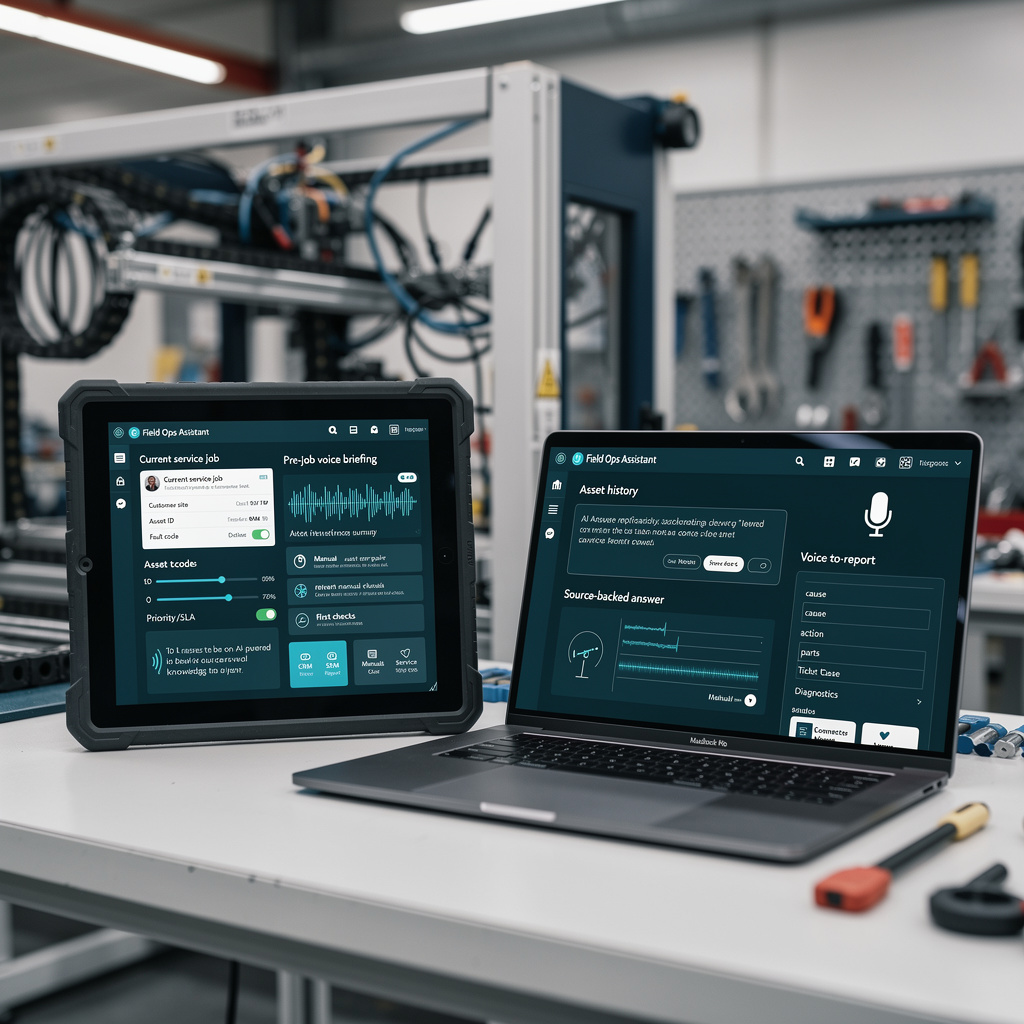
Field Ops Assistant does not replace CRM, FSM, ticketing, or documentation tools. It connects their data into a RAG-based service knowledge base and turns it into practical technician workflows.
CRM/FSM tickets, service reports, manuals, schematics, drawings, PDFs, DMS content, customer data, and asset history become one searchable service brain.
The assistant uses the current ticket, asset, customer site, fault pattern, and past cases to create short answers and relevant briefings.
Completed jobs and dictated reports become structured service knowledge that improves the next briefing and the next troubleshooting answer.
Field Ops Assistant gives technicians the right context before the visit, source-backed guidance during troubleshooting, and structured documentation after the job.
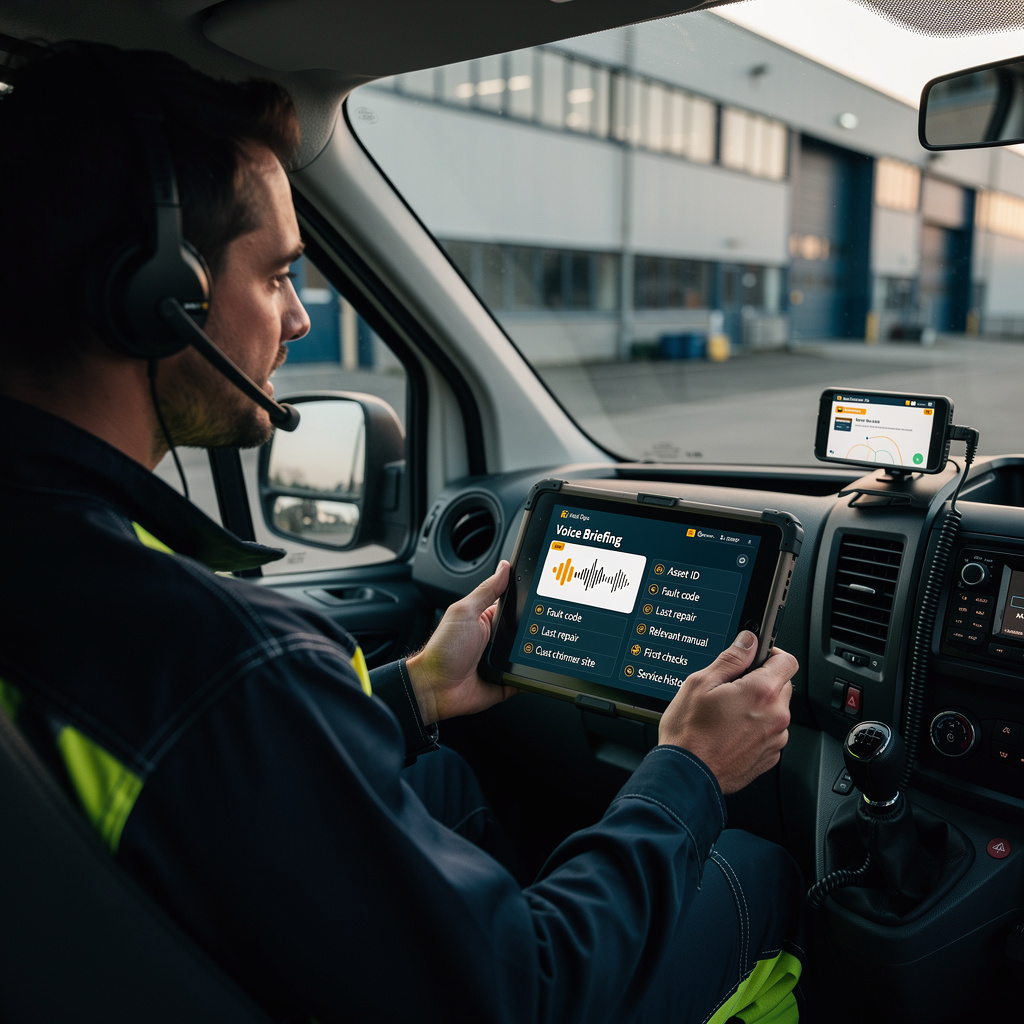
On the way to the customer, the technician can listen to a short briefing: what happened, what was done last time, which documents matter, and what to check first.
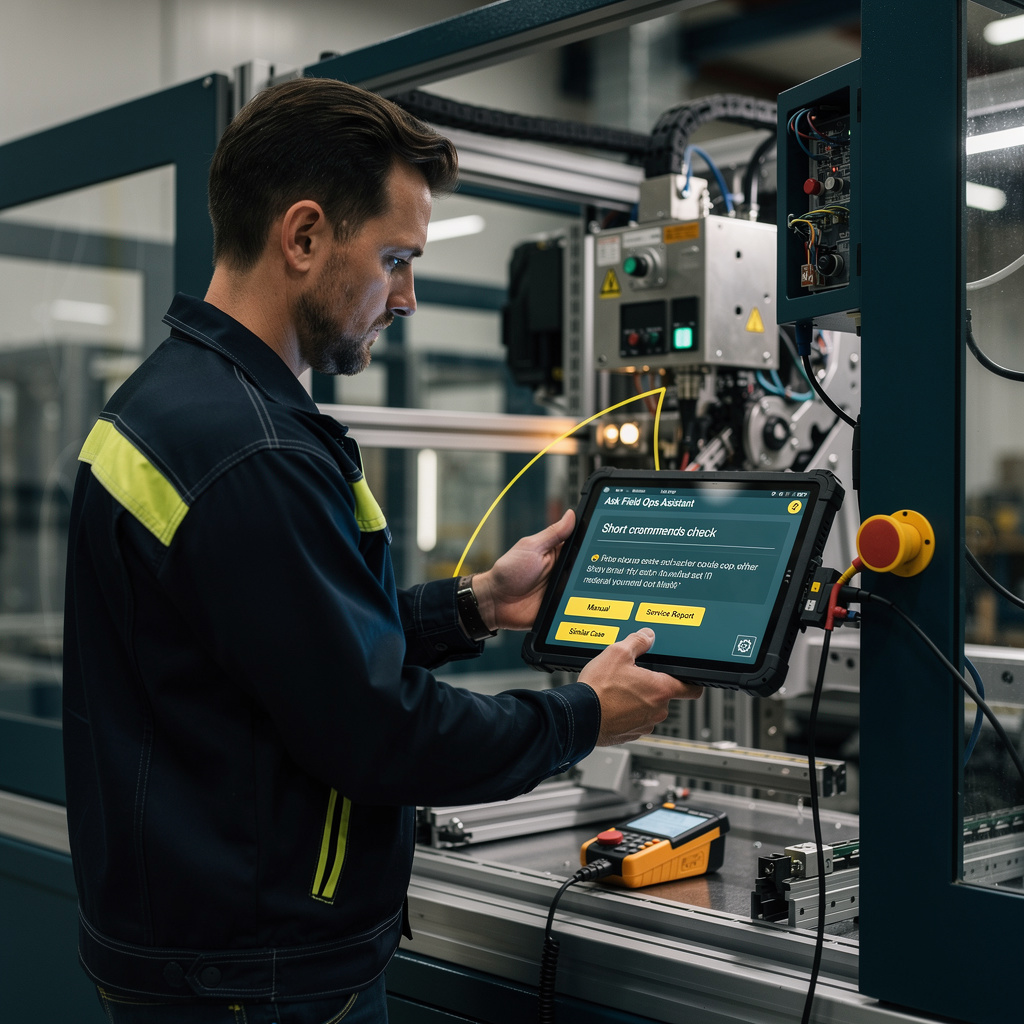
During troubleshooting, technicians ask by fault code, symptom, component, or asset. The assistant returns relevant document sections, similar cases, and recommended checks in the context of the current job.
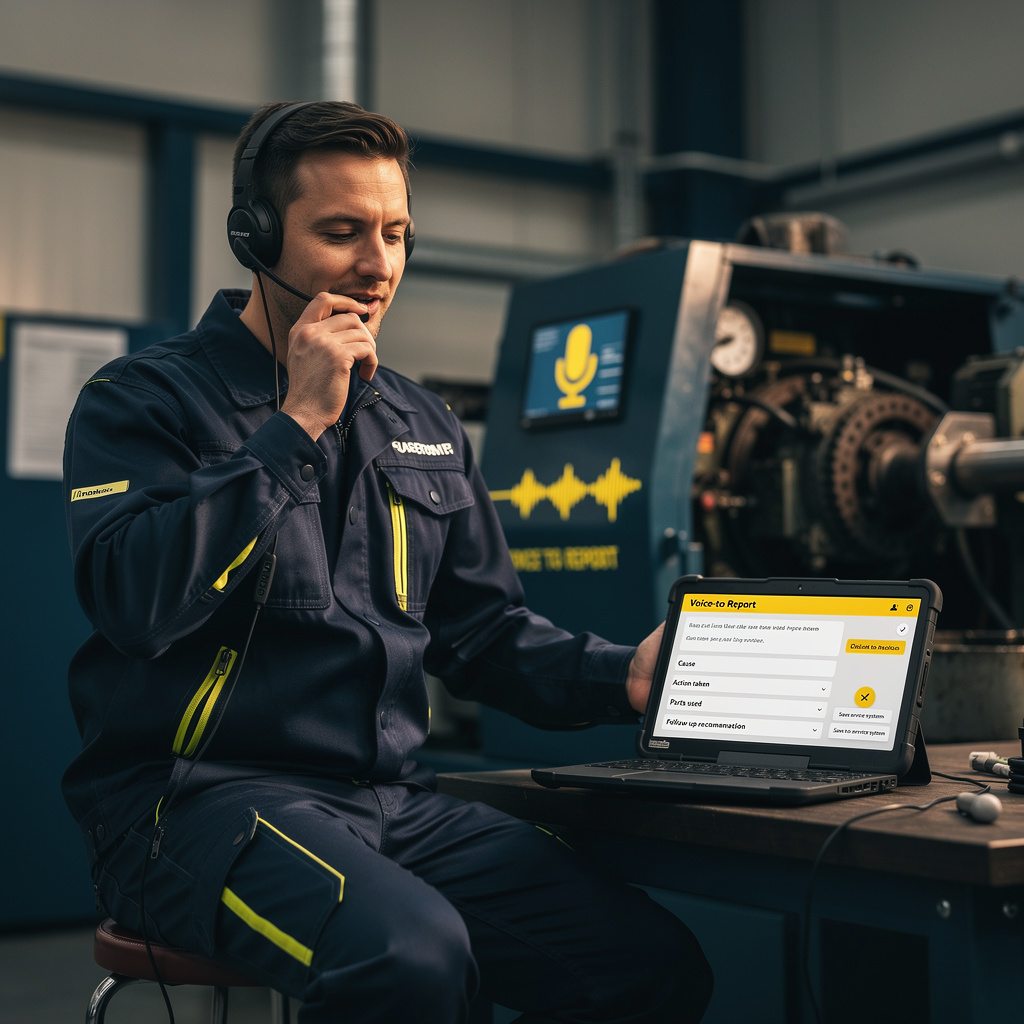
After the job, the technician dictates the outcome. Field Ops Assistant creates a structured service record with actions, cause, parts, and result — and stores it as reusable knowledge.
Pilots validate the actual impact on preparation time, search time, documentation effort, diagnostic time, and knowledge reuse.
Field Ops Assistant is the intelligence and knowledge layer above existing tools. CRM, FSM, ticketing, DMS, diagnostics, and inventory remain the leading systems for work orders, status, SLAs, documents, parts, and machine data.
The value is not a generic chatbot. It is job-specific service context, trustworthy source-backed answers, and a learning loop that improves after every completed job.
Answers are grounded in the current ticket, asset, customer site, service history, fault pattern, and approved documentation.
Answers are based on approved knowledge sources and service history, with source references so technicians can verify critical information.
Dictated reports, outcomes, parts, causes, and fixes become structured knowledge that improves future briefings and troubleshooting flows.
Every package combines a yearly platform fee for integrations, indexing, and governance with monthly technician seats for active field users.
For technical aftersales teams starting with one region and limited integrations.
+ €10k yearly platform fee
For growing service organizations with more regions, roles, and source systems.
+ €90k yearly platform fee
For larger organizations with multiple regions, governance needs, and system complexity.
+ €480k yearly platform fee
For global or very large service organizations with custom rollout, procurement, and governance requirements.
Custom yearly platform, seat, or site/region model
Start with 10 technicians, one high-frequency fault family, and 2–3 high-value knowledge sources. Measure preparation time, search time, documentation effort, diagnostic time, and knowledge reuse before scaling.